1)Silicon carbide whiskers should be pre-dispersed as much as possible before use. They should be mechanically and ultrasonically dispersed with water, ethanol, etc., and then mixed with the matrix material.
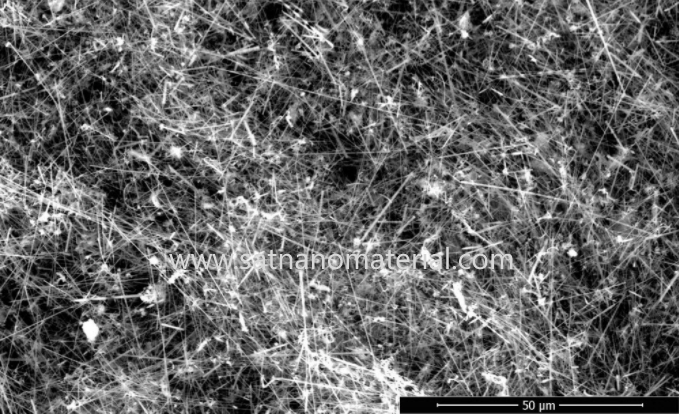
2) The amount of silicon carbide whiskers added to the material is not as high as possible, and there is usually an optimum value. Ordinary ceramics are generally added in an amount of 1-10%. The greater the true density of the matrix material, the lower the amount of silicon carbide whiskers added; the organic composite material is added in an amount of 0.5-3%.
3) When silicon carbide whiskers are mixed with ceramic materials, mechanical agitation or slurry wet ball milling is recommended to reduce the chance of silicon carbide whiskers breaking under high-intensity mixing conditions.
4) Low-viscosity silicon carbide whisker composite slurry, it is recommended to use rotary evaporation drying, or as large as possible to form a large-area thin layer of slurry to avoid the silicon carbide whisker and matrix material grains in the drying process Floor.
5) In the high temperature sintering or high temperature mixing process, an inert atmosphere or vacuum should be introduced to prevent the silicon carbide whiskers from reacting with oxygen and nitrogen under high temperature conditions, resulting in structural damage and performance degradation.
6) The silicon carbide whisker should be surface-modified with a coupling agent before mixing with the resin material to enhance the bonding strength between the silicon carbide whisker and the resin matrix. The coupling agent should be selected according to the resin type and product requirements.
7) Through the extrusion molding, injection molding, electrophoresis, etc., according to the performance requirements of the product, the directional arrangement of the silicon carbide whiskers in the matrix material can be realized. Generally, the arrangement direction of the silicon carbide whiskers is random.
8) Although it has been subjected to pickling and purification, it is recommended that customers use acid pickling to remove adsorbate when used in semiconductor, catalytic and other research to improve the activity and achieve the best research results.
SAT nano Technology Material Co., Ltd.is committed to providing comprehensive products, services and solutions for advanced materials research, serving the research and production activities of universities, research institutes and enterprises and institutions across the country. The company's product line covers metal materials, ceramic materials (nitrides, carbides, borides, silicides, oxides, etc.), nanomaterials, rare earth materials and other industrial fields, widely used in metallurgy, petroleum, chemical, electronics, Machinery, automotive, power station, environmental protection and aviation, aerospace and other fields are the best choice for you to develop and produce high value-added innovative products.
4) Low-viscosity silicon carbide whisker composite slurry, it is recommended to use rotary evaporation drying, or as large as possible to form a large-area thin layer of slurry to avoid the silicon carbide whisker and matrix material grains in the drying process Floor.
5) In the high temperature sintering or high temperature mixing process, an inert atmosphere or vacuum should be introduced to prevent the silicon carbide whiskers from reacting with oxygen and nitrogen under high temperature conditions, resulting in structural damage and performance degradation.
6) The silicon carbide whisker should be surface-modified with a coupling agent before mixing with the resin material to enhance the bonding strength between the silicon carbide whisker and the resin matrix. The coupling agent should be selected according to the resin type and product requirements.
7) Through the extrusion molding, injection molding, electrophoresis, etc., according to the performance requirements of the product, the directional arrangement of the silicon carbide whiskers in the matrix material can be realized. Generally, the arrangement direction of the silicon carbide whiskers is random.
8) Although it has been subjected to pickling and purification, it is recommended that customers use acid pickling to remove adsorbate when used in semiconductor, catalytic and other research to improve the activity and achieve the best research results.
SAT nano Technology Material Co., Ltd.is committed to providing comprehensive products, services and solutions for advanced materials research, serving the research and production activities of universities, research institutes and enterprises and institutions across the country. The company's product line covers metal materials, ceramic materials (nitrides, carbides, borides, silicides, oxides, etc.), nanomaterials, rare earth materials and other industrial fields, widely used in metallurgy, petroleum, chemical, electronics, Machinery, automotive, power station, environmental protection and aviation, aerospace and other fields are the best choice for you to develop and produce high value-added innovative products.
评论
发表评论